Reading 1: Generations TogetherThe traditional Kuwaiti home was more than just a place to live. It was the heart of family life. In the past, families lived in large, connected homes, often under one roof with grandparents, parents, and children. These houses were designed to bond family members with each other, a value that still strongly shapes Kuwaiti life today.
At the centre of every traditional home was a large courtyard where family members would gather to talk, share meals, and celebrate special events. These homes were spacious and open, allowing them to stay happily connected. Today, most homes do not have courtyards, but the feeling of being close is still present. Respect for elders, kindness, and a spirit of hospitality are values Kuwaitis still practise today. Guests are always welcomed with Arabic coffee, dates, and warm smiles, which shows the importance of hospitality in everyday life.
Each family member had a clear role, and everyone supported one another. Men protected their families and worked to provide for their needs, while women managed the home with care. Boys worked with their fathers, and girls helped their mothers at home. These traditions taught children important values such as wisdom, respect, and cooperation. In fact, these values still guide Kuwaiti families today. The grandparents held the family together with their love and wisdom, guiding the younger generation with gentle hearts and strong values.
Children also gathered around their grandparents to enjoy ghatawi, traditional riddles. Boys played marbles, known as teyal, while girls enjoyed playing haila, a hopping game. However, the children’s favourite activity of all was playing hide and seek, seda ma’seda, a joyful game that filled the courtyard with laughter.
In short, the traditional Kuwaiti home reflected a united spirit of respect and love, just as the Kuwaiti culture continues to do today.
كان المنزل الكويتي التقليدي أكثر من مجرد مكان للعيش. فقد كان قلب الحياة الأسرية. في الماضي، كانت العائلات تعيش في منازل كبيرة ومتصلة، وغالبًا تحت سقف واحد مع الأجداد والآباء والأبناء. وقد صُممت هذه البيوت لتعزيز الروابط بين أفراد الأسرة، وهو ما يزال قيمة تؤثر بقوة في حياة الكويتيين اليوم.
وكان يوجد في وسط كل منزل تقليدي فناء واسع، يجتمع فيه أفراد الأسرة للحديث وتناول الطعام والاحتفال بالمناسبات الخاصة. وكانت هذه البيوت فسيحة ومفتوحة، مما أتاح لأفرادها البقاء على تواصل وسعادة. أما اليوم، فمعظم المنازل لا تحتوي على أفنية، لكن الشعور بالقرب لا يزال حاضرًا. وما زال الكويتيون يمارسون قيم احترام الكبار، واللطف، وروح الضيافة. فالضيوف يُستقبلون دائمًا بالقهوة العربية والتمر والابتسامات الدافئة، مما يعكس أهمية الضيافة في الحياة اليومية.
وكان لكل فرد من أفراد الأسرة دور واضح، وكان الجميع يدعم بعضهم البعض. كان الرجال يحمون أسرهم ويعملون لتلبية احتياجاتها، بينما كانت النساء تدير المنزل بعناية. وكان الأولاد يعملون مع آبائهم، وتساعد البنات أمهاتهن في المنزل. وقد علّمت هذه التقاليد الأطفال قيمًا مهمة مثل الحكمة والاحترام والتعاون. وفي الحقيقة، لا تزال هذه القيم توجه الأسر الكويتية حتى اليوم. وكان الأجداد يجمعون الأسرة بمحبتهم وحكمتهم، ويقودون الجيل الأصغر بقلوبهم الطيبة وقيمهم الراسخة.
كما كان الأطفال يجتمعون حول جدهم للاستمتاع بالحكاوي، الألغاز التقليدية. كان الأولاد يلعبون الكرات الزجاجية، المعروفة باسم "التيل"، بينما كانت الفتيات يستمتعن بلعبة الحجلة، وهي لعبة قفز. ومع ذلك، كانت اللعبة المفضلة لدى جميع الأطفال هي لعبة الغميضة، "سيدة مسعدة"، وهي لعبة مرحة ملأت ساحة المنزل بالضحك.
وباختصار، كان المنزل الكويتي التقليدي يعكس روحًا موحدة من الاحترام والمحبة، تمامًا كما تواصل الثقافة الكويتية القيام بذلك اليوم.
Reading 2: Sharing My CultureTo: Ahmed
Subject: Tell Me About Your Kuwaiti Family
Dear Ahmed,
Hello, I hope you and your family are doing well. First, I would love to learn more about your life in Kuwait. In addition, could you tell me more about your family as well? I’m really interested in your culture. Take care!
Best Regards,
Tom
To: Tom
Subject: My Family in Kuwait
Dear Tom,
Hello, we are well, thank you. I hope you are well too! First, let me tell you about my family. I live in a large house near Kuwait City with my parents, my younger sister, Lulwa, and my older brother, Jassim. In addition, my father is a doctor at Jaber Hospital, and my mother teaches Arabic at a school. I love spending time with my grandparents because they share amazing stories about Kuwait’s past and heritage. Every Friday, we usually go to the mosque for Al-Jumu’ah prayer. After that, we have a big family lunch at my grandfather’s house. We call it Zuwara. It’s a tradition where all the relatives gather to enjoy delicious food and have a brilliant time together. As a result, we are a very close family, and I always look forward to these gatherings!
Sometimes, I also go with my dad to the Diwaniya. It’s a weekly gathering where men talk about life, sports, and news. It’s a special part of our Kuwaiti heritage, and I feel extremely proud to be a part of it. We also relax, laugh, and show respect for each other’s opinions. I have many friends there too. Finally, you should definitely visit us one day!
Write back and tell me more about your family and friends, too!
Best regards,
Ahmed
عزيزي أحمد،
مرحبًا، آمل أن تكون أنت وعائلتك بخير. أولًا، أود أن أتعرف أكثر على حياتك في الكويت. بالإضافة إلى ذلك، هل يمكنك أن تخبرني المزيد عن عائلتك أيضًا؟ أنا مهتم جدًا بثقافتكم. اعتنِ بنفسك!
مع أطيب التحيات،
توم
عزيزي توم،
مرحبًا، نحن بخير، شكرًا لك. آمل أن تكون بخير أيضًا! أولًا، دعني أخبرك عن عائلتي. أعيش في منزل كبير بالقرب من مدينة الكويت مع والديّ، وأختي الصغرى لولوة، وأخي الأكبر جاسم. بالإضافة إلى ذلك، يعمل والدي طبيبًا في مستشفى جابر، ووالدتي تدرّس اللغة العربية في مدرسة. أحب قضاء الوقت مع جدي وجدتي لأنهما يرويان قصصًا رائعة عن ماضي الكويت وتراثها. في كل يوم جمعة، نذهب عادةً إلى المسجد لصلاة الجمعة. بعد ذلك، نتناول غداءً عائليًا كبيرًا في بيت جدي. نسميه "زوارة". إنها عادة يجتمع فيها جميع الأقارب للاستمتاع بالطعام اللذيذ وقضاء وقت رائع معًا. ونتيجة لذلك، نحن عائلة مترابطة جدًا، ودائمًا أنتظر هذه اللقاءات بفارغ الصبر!
أحيانًا، أذهب أيضًا مع والدي إلى الديوانية. إنها تجمع أسبوعي يتحدث فيه الرجال عن الحياة والرياضة والأخبار. إنها جزء مميز من تراثنا الكويتي، وأشعر بفخر كبير لكوني جزءًا منها. كما أننا نستمتع ونضحك ونبدي احترامنا لآراء بعضنا البعض. لدي الكثير من الأصدقاء هناك أيضًا. أخيرًا، يجب عليك أن تزورنا يومًا ما بالتأكيد!
اكتب لي وأخبرني المزيد عن عائلتك وأصدقائك أيضًا!
مع أطيب التحيات،
أحمد
Match each word with its meaning.
صل كل كلمة بمعناها.
- bond (v) = يربط – يجمع الشمل
- strongly (adv) = بقوة – بشدة
- courtyard (n) = فناء – ساحة
- gather (v) = يتجمع – يتلاقى
- spacious (adj) = واسع – فسيح
- happily (adv) = بسعادة
Match each word with its meaning.
صل كل كلمة بمعناها.
- elder (n) = كبير بالعمر
- hospitality (n) = حسن الضيافة
- role (n) = دور
- manage (v) = يدير
- wisdom (n) = الحكمة
- united (adj) = موحد – متحد
Match each word with its meaning.
صل كل كلمة بمعناها.
- culture (n) = الثقافة
- share (v) = يشارك – ينشر
- heritage (n) = التراث
- tradition (n) = التقاليد
- brilliant (adj) = مبهر – ذكي جدًا
- close (adj) = قريب
Match each word with its meaning.
صل كل كلمة بمعناها.
- look forward to (phv) = يتشوق إلى
- weekly (adj) = أسبوعي
- extremely (adv) = بشكل شديد – جدًا
- relax (v) = يسترخي
- definitely (adv) = بدون شك
Look at the pictures only. Classify the descriptions of the two houses.
انظر للصور ثم صنّف أوصاف المنزلين.
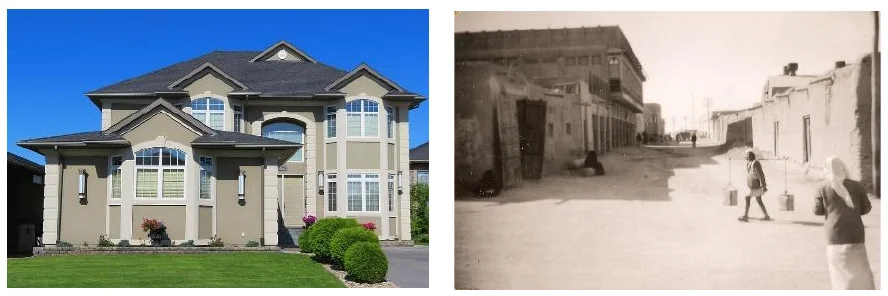
- small = old traditional Kuwaiti house
- made of clay = old traditional Kuwaiti house
- large = modern house
- modern = modern house
One of the following can be the best title for the passage.
واحد من التالي هو العنوان الأفضل للفقرة.
- Large Courtyards Inside Houses
- Traditional Houses significance to Families
- Homes Around the World
- Decorating our Homes Nicely
What is the writer’s purpose? It is to show that traditional Kuwaiti homes were:
ما هدف الكاتب؟ من أجل بيان أن المنازل الكويتية التقليدية كانت ......
- able to bond family members and strengthen family values.
- a place to relax.
- small and made of clay.
- built to keep people safe inside.
The underlined pronoun “them” in the 2nd paragraph refers to:
الضمير الذي تحته خط يعود على:
- meals
- family members
- special events
- homes
Classify the following into traditional Kuwait games and family values.
صنّف ما يلي إلى الألعاب التقليدية الكويتية والقيم الأسرية.
- Teyal = Traditional Kuwait games
- Haila = Traditional Kuwait games
- hide and seek (seda ma’seda) = Traditional Kuwait games
- respect = Family values
- kindness = Family values
- cooperation = Family values
- hospitality = Family values
How should we start our e-mail?
كيف يجب أن نبدأ بريدنا الإلكتروني؟
- We usually start an e-mail by writing “Take care! Best regards”.
- We usually start an e-mail by writing our name.
- We usually start an e-mail by writing “Best regards”.
- We usually start an e-mail by writing “Dear” then a polite regard.
What do we write to end our e-mail?
ماذا نكتب لإنهاء بريدنا الإلكتروني؟
- We usually end an e-mail by writing “Dear”.
- We usually end an e-mail by writing “Hello”.
- We usually end an e-mail by writing the subject.
- We usually end an e-mail by writing “Take care! Best regards”.
The opposite of the word “relax” is:
عكس كلمة التي تحتها خط هو:
Why does Ahmed love spending time with his grandparents?
لماذا يحب أحمد قضاء الوقت مع جديه؟
- Because his father is a doctor at Jaber Hospital.
- Because they share amazing stories about Kuwait’s past and heritage.
- Because they teach Arabic at a school.
- Because they go to the Diwaniya every week.
Complete the chart with examples of traditional Kuwaiti gatherings and their importance.
أكمل المخطط بأمثلة على التجمعات التقليدية الكويتية وأهميتها.
- meet our relatives = Zuwara
- make the family close = Zuwara
- where men meet = Diwaniya
- talk about life, sport and news = Diwaniya
She …… to school by bus every day. (go)
صحح الفعل بين القوسين.
They …… football on weekends. (play)
صحح الفعل بين القوسين.
My father usually …… the car every Sunday. (wash)
صحح الفعل بين القوسين.
The baby always …… when she is hungry. (cry)
صحح الفعل بين القوسين.
We …… lunch at noon. (have)
صحح الفعل بين القوسين.
Make the sentence negative. She likes coffee. → She …… coffee.
حوّل الجملة إلى النفي.
Choose the correct question for the sentence: She likes coffee.
اختر السؤال الصحيح للجملة:
- What does she likes?
- What she likes?
- What does she like?
- What do she like?
Make the sentence negative. They play football. → They …… football.
حوّل الجملة إلى النفي.
Choose the correct question for the sentence: They play football.
اختر السؤال الصحيح للجملة:
- What do they play?
- What does they play?
- What they play?
- What do they plays?
Make the sentence negative. He reads every day. → He …… every day.
حوّل الجملة إلى النفي.
Choose the correct question for the sentence: He reads every day.
اختر السؤال الصحيح للجملة:
- When does he reads?
- When do he read?
- When does he read?
- When he reads?
Make the sentence negative. We go to school. → We …… to school.
حوّل الجملة إلى النفي.
Choose the correct question for the sentence: We go to school.
اختر السؤال الصحيح للجملة:
- Where do you go?
- Where does you go?
- Where you go?
- Where do you goes?
Make the sentence negative. I watch TV at night. → I …… TV at night.
حوّل الجملة إلى النفي.
Choose the correct question for the sentence: I watch TV at night.
اختر السؤال الصحيح للجملة:
- What do you watch at night?
- What does you watch at night?
- What you watch at night?
- What do you watches at night?
Make the sentence negative. The cat sleeps on the bed. → The cat …… on the bed.
حوّل الجملة إلى النفي.
Choose the correct question for the sentence: The cat sleeps on the bed.
اختر السؤال الصحيح للجملة:
- Where does the cat sleeps?
- Where does the cat sleep?
- Where do the cat sleep?
- Where the cat sleeps?
Make the sentence negative. Ahmed likes music. → Ahmed …… music.
حوّل الجملة إلى النفي.
Choose the correct question for the sentence: Ahmed likes music.
اختر السؤال الصحيح للجملة:
- Who does likes music?
- Who likes music?
- Who like music?
- Who do likes music?
Make the sentence negative. Yes, she works in a hospital. → She …… in a hospital.
حوّل الجملة إلى النفي.
Choose the correct question for the sentence: Yes, she works in a hospital.
اختر السؤال الصحيح للجملة:
- Does she works in a hospital?
- Do she work in a hospital?
- Does she work in a hospital?
- Is she work in a hospital?
Make the sentence negative. He drives a big truck. → He …… a big truck.
حوّل الجملة إلى النفي.
Choose the correct question for the sentence: He drives a big truck.
اختر السؤال الصحيح للجملة:
- What does he drives?
- What do he drive?
- What he drives?
- What does he drive?
Make the sentence negative. Birds fly in the sky. → Birds …… in the sky.
حوّل الجملة إلى النفي.
Choose the correct question for the sentence: Birds fly in the sky.
اختر السؤال الصحيح للجملة:
- Where does birds fly?
- Where do birds fly?
- Where birds fly?
- Where do birds flies?
Ahmed …… a nice modern house.
أكمل بـ has got أو have got.
The girl …… some beautiful cats.
أكمل بـ has got أو have got.
We …… homework to do.
أكمل بـ has got أو have got.
I …… a lot of things to finish.
أكمل بـ has got أو have got.
Make the sentence negative. I have got brothers and sisters. → I …… brothers or sisters.
حوّل الجملة إلى النفي.
Choose the correct question for the sentence: I have got brothers and sisters.
اختر السؤال الصحيح للجملة:
- Has you got brothers or sisters?
- Have you got brothers or sisters?
- Have you gets brothers or sisters?
- Have you get brothers or sisters?
Make the sentence negative. She has got a pet at home. → She …… a pet at home.
حوّل الجملة إلى النفي.
Choose the correct question for the sentence: She has got a pet at home.
اختر السؤال الصحيح للجملة:
- What has she got at home?
- What have she got at home?
- What she has got at home?
- What has she gets at home?
Make the sentence negative. We have got enough time to finish the project. → We …… enough time to finish the project.
حوّل الجملة إلى النفي.
Choose the correct question for the sentence: We have got enough time to finish the project.
اختر السؤال الصحيح للجملة:
- Has we got enough time to finish the project?
- Have we got enough time to finish the project?
- Do we have got enough time to finish the project?
- Have we gets enough time to finish the project?
Make the sentence negative. He has got a car. → He …… a car.
حوّل الجملة إلى النفي.
Choose the correct question for the sentence: He has got a car.
اختر السؤال الصحيح للجملة:
- What have he got?
- What he has got?
- What has he got?
- What has he gets?
Make the sentence negative. They have got some money right now. → They …… any money right now.
حوّل الجملة إلى النفي.
Choose the correct question for the sentence: They have got some money right now.
اختر السؤال الصحيح للجملة:
- Has they got any money right now?
- Do they have got any money right now?
- Have they got any money right now?
- Have they gets any money right now?
Make the sentence negative. The boys have got new books. → The boys …… new books.
حوّل الجملة إلى النفي.
Choose the correct question for the sentence: The boys have got new books.
اختر السؤال الصحيح للجملة:
- Who has got new books?
- Who is got new books?
- Who does has got new books?
- Who got has new books?
Make the sentence negative. She has got homework today. → She …… homework today.
حوّل الجملة إلى النفي.
Choose the correct question for the sentence: She has got homework today.
اختر السؤال الصحيح للجملة:
- When have she got homework?
- When she has got homework?
- When has she gets homework?
- When has she got homework?
Make the sentence negative. They have got a new house. → They …… a new house.
حوّل الجملة إلى النفي.
Choose the correct question for the sentence: They have got a new house.
اختر السؤال الصحيح للجملة:
- What has they got?
- What they have got?
- What have they got?
- What have they gets?
Make the sentence negative. He has got foreign friends at his school. → He …… foreign friends at his school.
حوّل الجملة إلى النفي.
Choose the correct question for the sentence: He has got foreign friends at his school.
اختر السؤال الصحيح للجملة:
- Where have he got foreign friends?
- Where has he got foreign friends?
- Where he has got foreign friends?
- Where has he gets foreign friends?
Make the sentence negative. We have got everything we need for the trip. → We …… everything we need for the trip.
حوّل الجملة إلى النفي.
Choose the correct question for the sentence: We have got everything we need for the trip.
اختر السؤال الصحيح للجملة:
- What has we got for the trip?
- What we have got for the trip?
- What have we gets for the trip?
- What have we got for the trip?
My Dream Home – writing outline: classify the supporting details into the two paragraphs.
منزل أحلامي – مخطط الكتابة: صنّف الأفكار الجزئية حسب الفقرتين.
- many rooms to enjoy my stay = Paragraph 1: Describing how it looks like
- spacious garden to grow flowers = Paragraph 1: Describing how it looks like
- modern living room to sit and watch TV = Paragraph 1: Describing how it looks like
- large diwaniya to meet our guests = Paragraph 2: Activities I can do there
- play the PlayStation with my brothers = Paragraph 2: Activities I can do there
- study on my desk = Paragraph 2: Activities I can do there
- have tea or cold drinks in the garden = Paragraph 2: Activities I can do there
My Dream Home (paragraph 1): put the sentences in the correct order.
رتّب جمل الفقرة الأولى.
- There is no place like home.
- My dream home is nice and large. It has got many rooms to enjoy my stay.
- First, it has got a spacious garden to grow flowers.
- Also, it has a modern living room to sit and watch TV with my family.
- I think living there will make me very happy.
My Dream Home (paragraph 2): put the sentences in the correct order.
رتّب جمل الفقرة الثانية.
- I can do so many things in my dream house.
- First, there is a large diwaniya to meet our guests at any time.
- Second, I can play the PlayStation with my brothers in our big TV.
- In addition, I have a big desk in my room so I can study and do my homework. Also, we can have tea or cold drinks in the garden.
- To sum up, I believe I will enjoy my time in it so much.
- There is nothing like home to feel relaxed.

 مدرس لغة انجليزيةأرقام مدرسين لغة انجليزية
 مدرسة لغة انجليزيةأرقام مدرسات لغة انجليزية